
Moebius
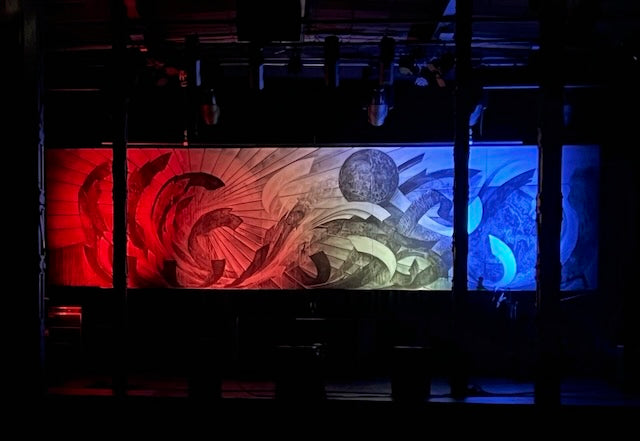
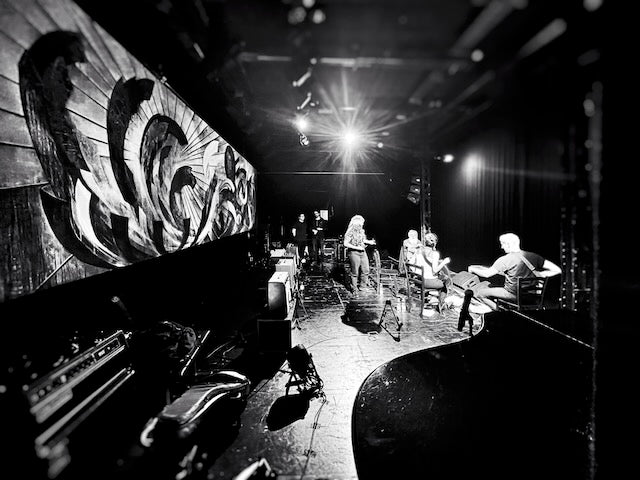
Moebius was originally created as a stage painting for the Unlimited Festival at the Alter Schlachthof in Wels, an international festival for experimental music.
-
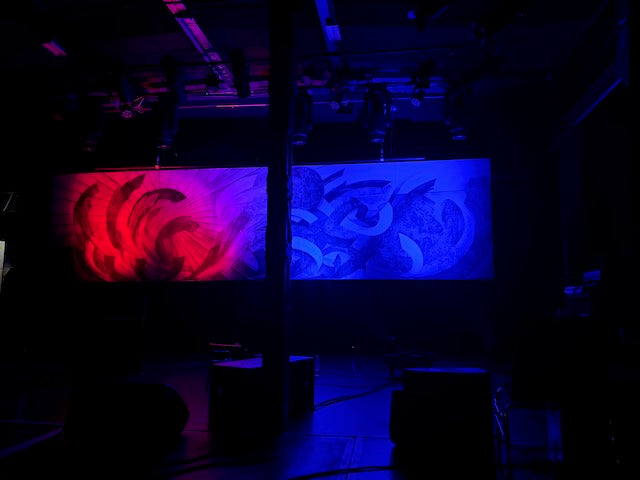
I deliberately chose a large-scale, almost monochrome painting. Black, white and grey instead of dominant colour — not as reduction, but as an opening. With around thirty bands performing on the same stage, I did not want each one to be locked into the same visual atmosphere. Through changing light, subtle shifts in colour and projections, each performance gained its own space, its own breath, its own tension. The painting remained the same — and yet was constantly transformed.
-
During the festival, it was striking to see how differently people responded to the painting. Some saw storms, spray and heavy seas. Others recognised landscapes, bodies, masks, nets or celestial movements. This openness is essential. Moebius does not depict an object, but a state — an inner and outer moment in which order, pressure, movement and change are active at the same time.


-
Formally, Moebius moves between constructed order and organic flow. On the left, something begins that feels almost architectural: steps, rays, a rhythmic field. Then the movement shifts. White breaks open like water, like sailcloth in the wind, like a moment when control is no longer enough. Dark arcs, loops and ribbon-like forms interlock, contract and dissolve again, forming a loop without an end. This is the core of the work: not a linear resolution, but feedback. Not an escape from chaos, but another way through it.
For me, this work is closely connected to the sea — not as a motif, but as a model for thinking. Weather, drift, friction, holding course, changing course. The loop does not end, but one can learn to move through it differently. Less resistance. More direction. This logic is closely connected to my artistic practice: elements, friction and changes of course as method, not merely as aesthetics.
Moebius marks precisely this point: the moment when something tips, intertwines, returns and, precisely through this, makes new movement possible.
-